What do PEGI age ratings on games mean?
PEGI age ratings on games tell you what kind of content a game has, not how hard it is, and here you can see what each number means and how to choose games.

PEGI age ratings on games, the numbers 3, 7, 12, 16 and 18, tell you what kind of content a game has, such as violence, scary scenes or purchases with real money. They say nothing about how difficult the game is. In Norway the rating is a recommendation, so parents decide what their child may play, and wherever you live, you are the one who knows your child best.
The new GTA comes out on 19 November 2026, and perhaps it is already on the Christmas list because others in the class are talking about it. The earlier GTA games are rated 18, and the new one is also made for adults. In 2024, the Norwegian Media Authority, Medietilsynet, found that 28 percent of boys and 10 percent of girls aged 9 to 10 in Norway who play games had played games rated 18. Six out of ten of the same age said their parents had made rules about which games they could play.
What do PEGI 3, 7, 12, 16 and 18 mean?
The number is the age PEGI considers the content suitable for. PEGI is the European system for age rating games. The label appears on game cases, among other places, and on pegi.info you can look up a game and see which rating it has.
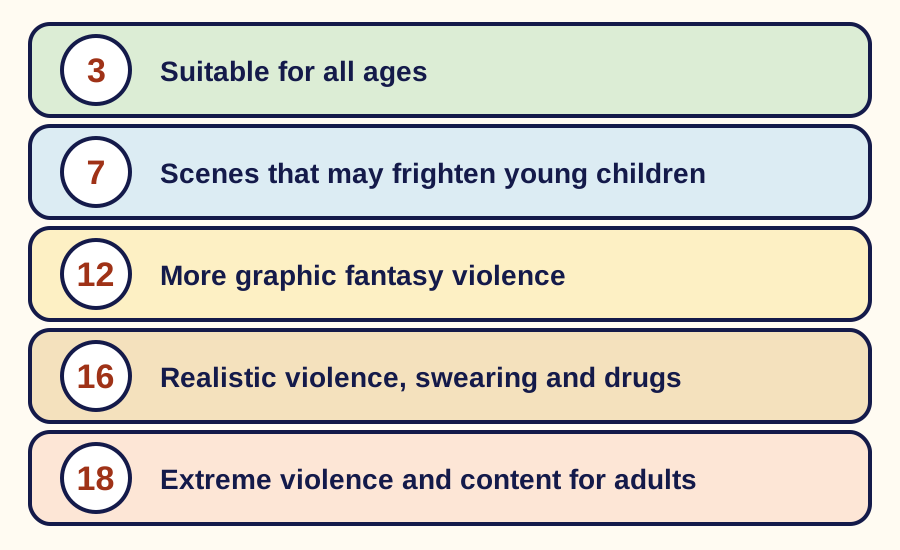
A game rated 3 can only have mild violence that seems comical or childlike. At 7, there may be scenes or sounds that could frighten young children. A game rated 12 can have slightly more graphic violence towards fantasy characters and mild bad language. At 16, violence looks the way it would in real life, and at 18 the violence is extreme, or the game has content meant only for adults.
Next to the number there are often small symbols that explain why the game got its rating, such as violence, bad language, fear, sex, drugs or gambling. The purchases symbol always appears when your child can buy something with real money inside the game. The symbols often tell you more than the number, because two games with the same number can be very different.
What changed in PEGI ratings from June 2026?
From June 2026, purchases, chat and pressure to keep playing also count towards the rating, not just what your child sees on screen. This means a game can get a higher rating because it pulls your child back or lets strangers write freely.
- Daily rewards. Games that give rewards for coming back every day are rated at least 7. If your child loses something by staying away, it becomes 12.
- Surprise purchases. Purchases where your child does not know what they will get until they have paid lead to at least 16 for games submitted to PEGI since June 2026.
- Chat. A game where chat cannot be blocked or muted and is not moderated is rated 18.
A game rated before June 2026 may carry a label that does not take this into account. From October 2026, PEGI is gradually moving games sold only digitally that are rated 3, 7 or 12 and have surprise purchases up to 16. Roblox is an example of how an age limit alone does not tell the whole story, and we have written about it in whether Roblox is safe for kids.
How can you choose games using the age rating?
Look at the number, the symbols and ideally the game itself before you decide. The number is a good place to start, but you know your child best.
For the youngest school children, games rated 3 or 7 often work well, ideally something you can play together. A child of 9 or 10 may enjoy a game rated 12, if you have seen what gives it the rating. If it says violence, you can watch a video of the game. If it mentions purchases, you can agree on who approves them.
A game rated 18 is made for adults. You can calmly say no and explain why, even when others in the class are allowed. Many parents have rules like this.
Suggest another game your child can look forward to, so that no is not the only answer.
Tonight, you can look at the Christmas list together with your child:
- Pick one game your child wants and look it up on pegi.info.
- Look at the number and the symbols together, and ask what your child thinks they mean.
- Explain in your own words what the number and the symbols stand for.
- Say what you have decided, and why.
Ten minutes is enough. If you wonder how games and learning apps fit into everyday life, you can read about learning apps and screen time.
At MOTH, we make learning apps for children, and the one we have released is Klokkeappen, where children practise telling the time on analogue and digital clocks with tasks read aloud and games. If you are looking for the purchases symbol, it may help to know that the app stores list no ads or purchases inside the app for Klokkeappen. It is a paid app meant for practice and repetition, and you can check supported languages and pricing in the app store.