How do I teach my child past and to on the clock?
In English, minutes count past the hour until half past and then to the next hour, and you can teach it by using half past as a turning point on the clock.
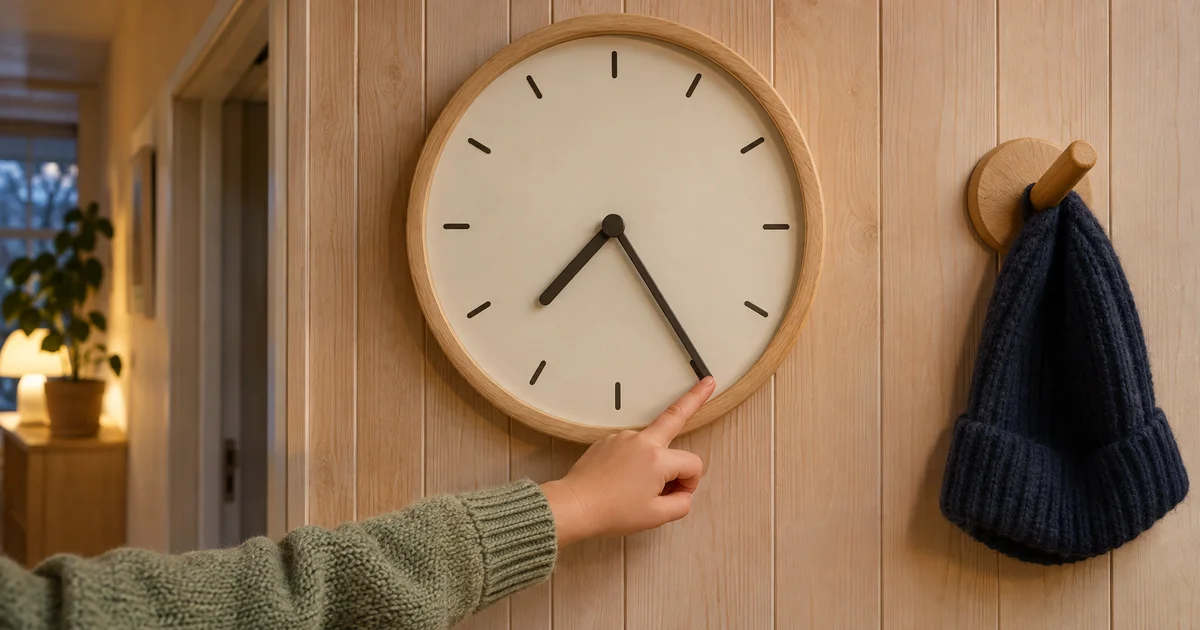
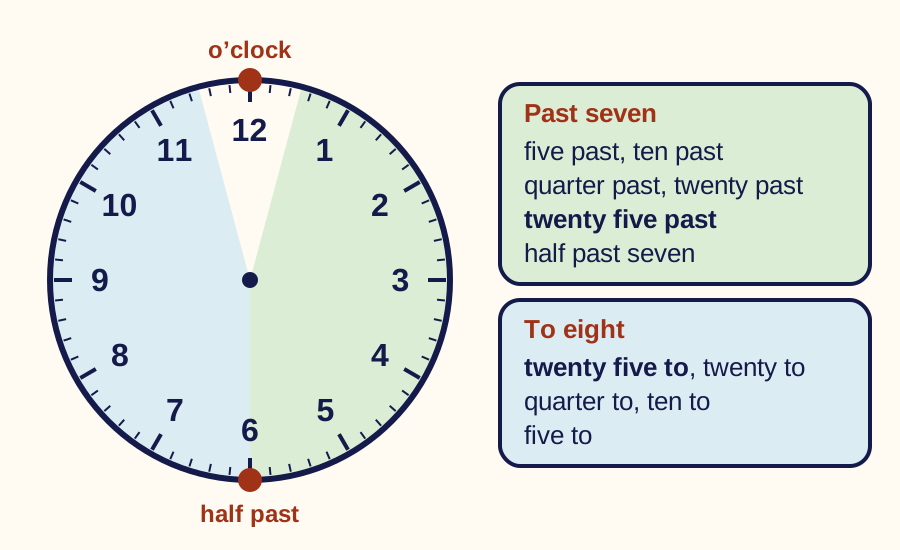
In English, minutes count past the hour until half past, and then to the next hour. So 7:25 is twenty five past seven, and 7:35 is twenty five to eight. You can teach past and to by showing your child that half past is a turning point at the bottom of the clock: on the right side of the face the long hand is going past, and on the left side it is counting down to the next hour.
Many children are happy with o'clock, half past and quarter past and to, and then get stuck on twenty five past and twenty five to. That is not surprising. The minute times ask your child to keep track of three things at once: the minutes, which side of the clock the long hand is on, and an hour that has not arrived yet. It takes time, and a little practice at a time is fine.
What do twenty five past and twenty five to mean?
Twenty five past seven means twenty five minutes after seven o'clock, and twenty five to eight means twenty five minutes before eight o'clock. When the long hand points to five, it is twenty five past. When it points to seven, it is twenty five to.
The hour changes at half past. Before it, you name the hour that has just passed. After it, you name the hour that is coming, even though the short hand is still between seven and eight. On a digital clock, twenty five past seven shows as 7:25 in the morning and 19:25 or 7:25 pm in the evening.
Twenty past and twenty to follow the same pattern. Twenty past seven is 7:20, and twenty to eight is 7:40.
Why are past and to tricky for children?
Past and to are tricky because the hour your child hears is not always the one the short hand has just passed. At 7:35 your child sees the short hand near seven and hears the word eight. Saying twenty five to seven is an easy slip, and it actually shows that your child is looking carefully at the hand.
It can help to show that the clock has two halves. On the right, from twelve down to six, the minutes are past the hour. On the left, from six back up to twelve, the minutes are to the next hour.
In Norway, the mathematics curriculum says that after year 2, when most children are seven or eight, pupils should be able to explain how time can be described with a clock and a calendar. It does not say when children should know the minute times, so the timing varies from class to class. If half past and quarters are still new, it is fine to wait. In the order your child can learn to tell the time in, minutes come last.
Children who hear Norwegian, Swedish or Danish as well as English have one more thing to untangle. In those languages 7:25 is called five to half eight, counted from half past instead of from the hour, and half eight means 7:30. In everyday British English, half eight means 8:30. It is a good idea to practise in one language at a time.
How can you practise past and to at home?
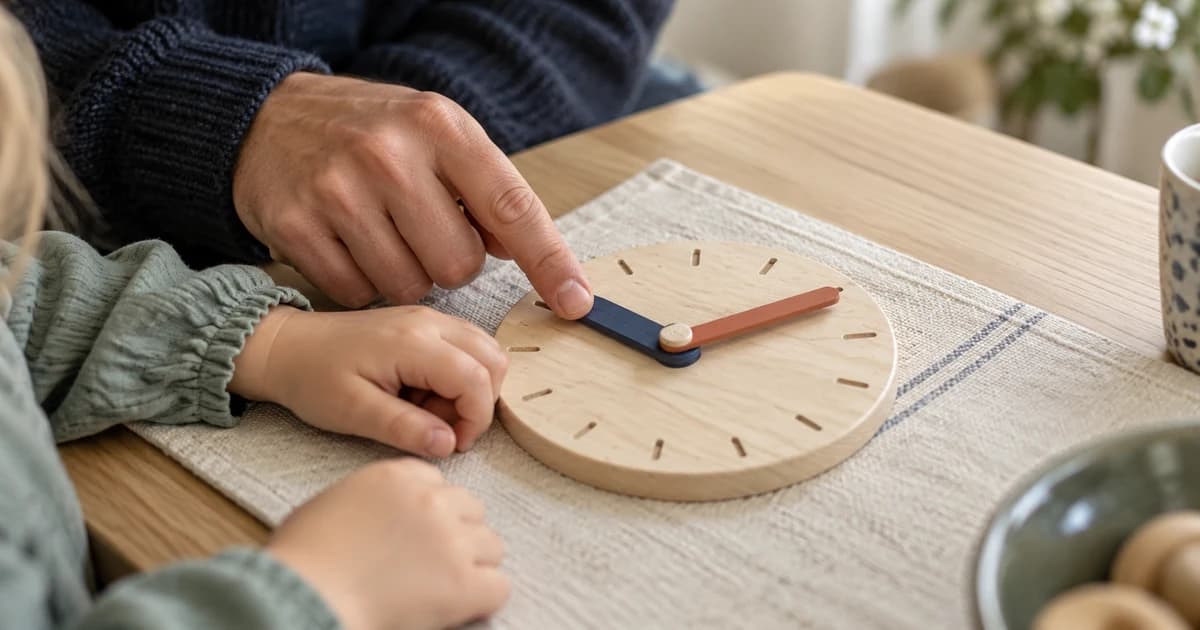
You can practise past and to by starting at half past, which your child already knows, and moving the long hand one number at a time. Then there is only one new step to think about each time.
A younger child of five or six does not need more than half past and maybe twenty five past. An older child can try saying the time both on the clock face and digitally, for example twenty five past seven and 7:25.
This evening you can try this with a clock you have at home, or a clock drawn on a paper plate:
- Set the clock to half past seven and ask your child what it shows.
- Move the long hand back one number and say: “Now it is five minutes before half past.” Let your child try to say the time.
- Move the hand to one number after half past and let your child say twenty five to eight.
- Swap roles, so your child moves the hand and you say the time.
Use a time your child cares about. If bedtime is half past seven, you can say “it is twenty five past, five minutes until we brush our teeth” when the clock says 7:25. Feeling five minutes pass is a different skill from reading it on the clock, and we have written about that in how long five minutes is to a child.
If your child would like more practice after you have looked at past and to together, we made Klokkeappen. It offers activities and games about analogue and digital time, with spoken instructions. It is meant for practice and repetition, so a new idea like twenty five to may still need an explanation from you first. The app stores list no ads or purchases within the app, and you can check supported languages and pricing there.