How do I make an activity advent calendar for kids?
You make an activity advent calendar by putting one small number task behind each door, and here are ideas for ages 5 to 10 and a start for tonight.

You make an activity advent calendar by writing 24 small notes with one short task on each, and putting a note behind each door or in each bag or box. Keep the tasks small enough to take about five minutes, and let many of them be about numbers: counting, finding the right door and working out how many days are left until Christmas. The calendar then becomes a few minutes with numbers every day, without feeling like homework.
Perhaps you already have an advent calendar with small gifts, and you would like a little less stuff and a little more time together. December is busy, so the calendar should not become another job for you. A note next to a small gift, or a note instead of some of the gifts, is enough.
Why is an advent calendar good for practising numbers?
An advent calendar is full of numbers your child already cares about. Every morning your child has to find the right door, and every day there is one day fewer to go until Christmas Eve.
On many calendars the doors are scattered in no particular order. When your child looks for door 14, they have to recognise a number with two digits and tell it apart from 41 or 4. When your child works out how many days are left, they can count backwards. In Norway, the mathematics curriculum says that after year 2, pupils should be able to experiment with counting both forwards and backwards, and explain how time can be described with a clock and a calendar.
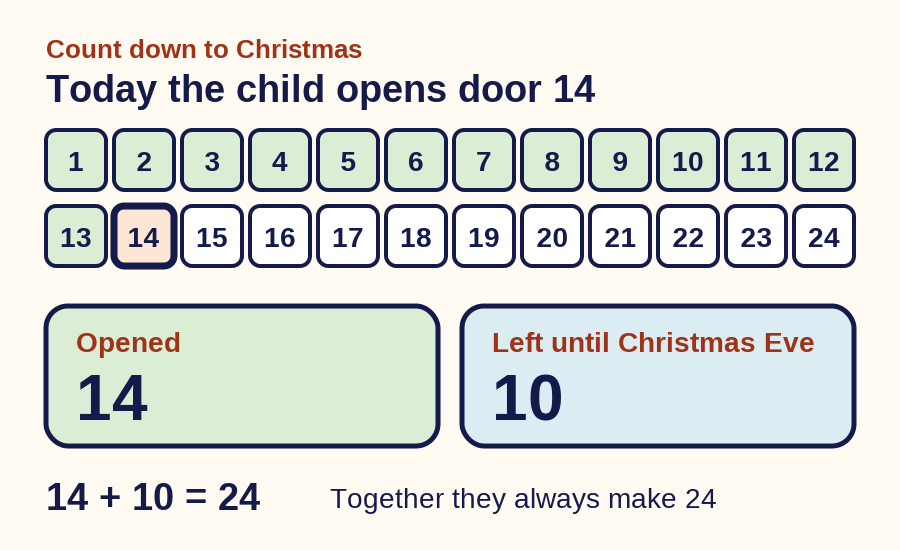
The figure shows a task that can grow with your child. A child of five can count the white doors with a finger. A child of eight can work out the answer in their head.
Which tasks suit children aged 5 to 10?
For a child aged 5 or 6, tasks where they count things and recognise numbers work well. For a child aged 8 to 10, the tasks can become small everyday sums.
Ideas for the youngest:
- Count the gingerbread biscuits on the plate, and ask if there are enough for everyone.
- Write the number on today's door with a finger on a misty window or in a little flour on a tray.
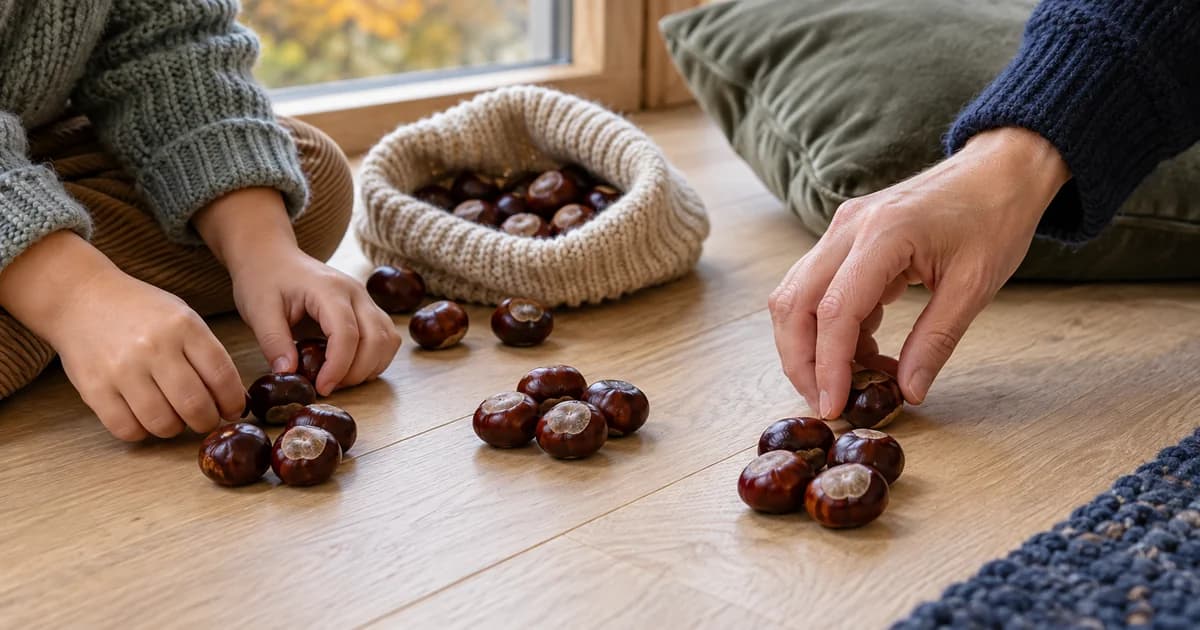
- Lay out as many nuts or pine cones as the number on the door. After the tenth, you can put ten in one pile and the rest beside it.
- Split a handful of raisins into two piles, and find out which pile has more.
Ideas for older children:
- How many days are left until Christmas Eve today?
- How many clementines do you need if everyone in the family gets two?
- How many days is it from one Sunday in Advent to the next?
- What is today's number plus today's number?
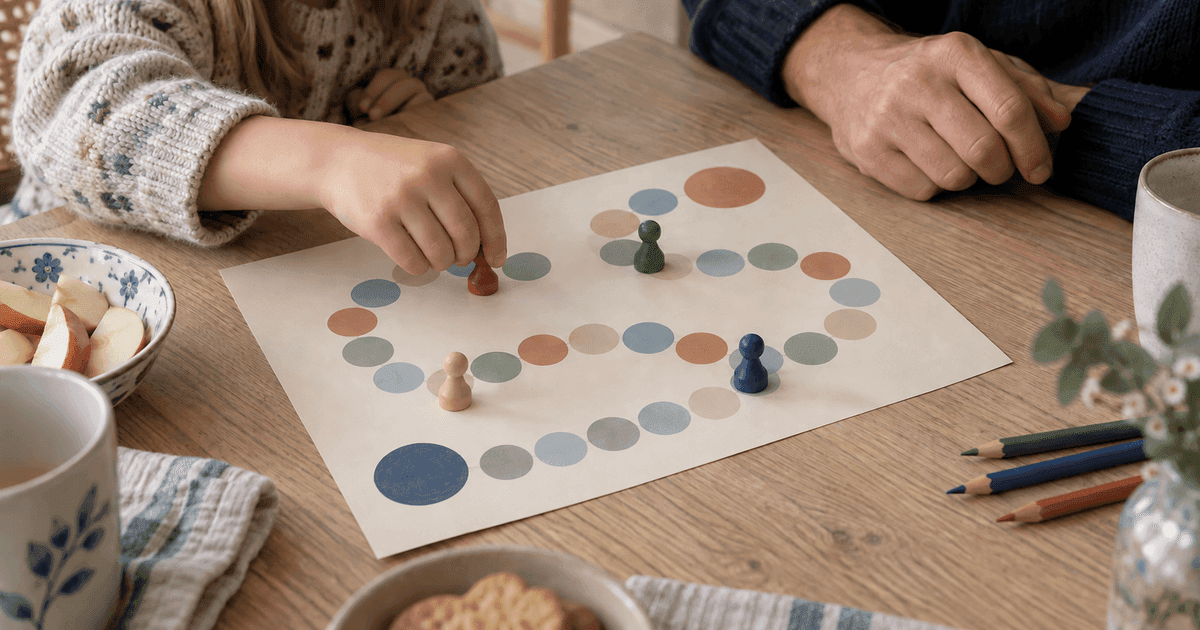
A child of seven is often somewhere in between. Try one task from each list and see what fits. If a task is too hard, you can solve it together with things on the table, just as your child does with dice and counters in board games where your child practises counting.
Let some of the notes be about something else entirely, such as baking, a walk with a lantern or reading a Christmas book. It is fine if not every day is about practice.
How do you keep the tasks small and enjoyable?
Keep each task to about five minutes, and it is fine to skip a day. The calendar should be something your child looks forward to, not something you have to fit in.
You do not need to write all 24 notes at once. Many parents find it easier to make one week at a time, for example on a Sunday. That way you can also adjust: if the tasks were too easy, you make next week's a little harder.
A child who cannot read yet can have the note read aloud. A child who reads can read the note themselves, and then they practise reading too. If your child gives a wrong answer, you can count together once more instead of correcting them. What you are after is the counting and the talking, not a right answer every day.
Tonight you can make the first week together:
- Get out seven slips of paper or small envelopes.
- Let your child write the numbers 1 to 7, one on each. A younger child can trace over numbers you have written in pencil.
- Write a short task on the back of each note, and mix in a few that are not about numbers.
- Let your child count the notes and put them in order from 1 to 7.
A quarter of an hour is enough. The first note can be opened on 1 December.
At MOTH, we have just released Tellevenn, a calm number game where children count, compare quantities and practise writing the digits 0 to 9 with a finger. It is made for children aged 3 to 5, so for older children the notes in the calendar are a better place to practise. The app has no ads, purchases inside the app or accounts, and it is only in Norwegian Bokmål and Serbian, not English. If it suits your child, you can download Tellevenn.