What does the Year 3 screening test in Norway mean?
Norway's Year 3 screening test looks for pupils who need extra help with reading and maths, and here you can see what the result means and what to do at home.
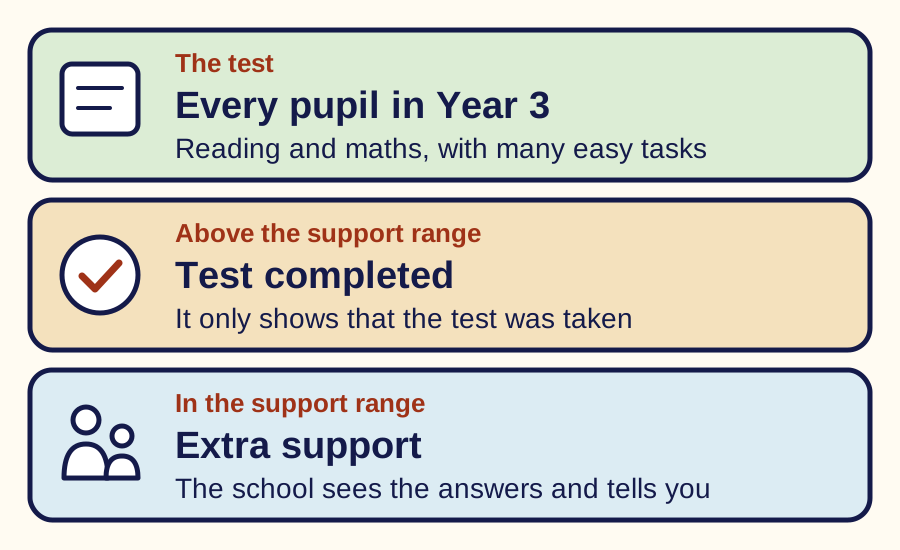
Norway's Year 3 screening test, the kartleggingsprøve, is a digital test in reading and maths that every pupil in the third year of school takes in the autumn. It is designed to find pupils who need extra support, and for everyone else it only shows that the test was taken. If the test shows that your child needs more help, the school must tell you and explain what happens next.
This year the testing period runs from 7 September to 16 October, so the test has been taken or is being taken in these weeks. Perhaps your child has mentioned it, or you have had a message from the school. The test is not an exam, and the idea is that children who need help with reading and maths are noticed early. This describes the Norwegian system, and schools elsewhere have their own arrangements.
What does the Year 3 screening test measure?
The screening test measures reading and maths using many easy tasks. The reading test covers reading words, understanding words, spelling and understanding what your child reads. The maths test has two parts, and pupils who are above the range where extra support is needed only take the first.
Because the test has many easy tasks, it says little about children who get almost everything right. It is designed to find the children who need more support.
The test also adapts to your child as it goes. Everyone starts with the same few tasks, and then children get different tasks depending on how they did.
That can explain things your child says at home. If your child says a friend got different tasks, or that the test stopped before the counter in the bottom corner reached the end, that is simply how the test works. The reading test contains more tasks than each child is given, and it ends by itself when your child has done theirs. There is no time limit either, so children finish at different times.
What does it mean if my child needs extra support?
If the result falls within what the Norwegian Directorate for Education and Training calls the oppfølgingsområde, or support range, the school must follow up your child's reading or maths more closely. You should be told what the result showed and what the school will put in place.
The result is a sign that your child needs more support right now. Children learn to read and do maths at different speeds, and the test is designed so that help comes early. If the school uses a different term, ask the teacher what it means for your child.
For children in the support range, the teacher can see the answer to each task. That makes it easier to ask specific questions:
- Which tasks were hard for my child?
- What will the school do now, and for how long?
- What can we do at home, and how much is enough?
- When will we talk again about how it is going?
If you have not heard anything but are still wondering, you can ask your child's class teacher. For more questions to bring, see what to ask at parents' evening.
How can you help your child at home after the test?
At home, you can help with short, calm moments of reading and numbers in everyday life, whatever the test showed. Once the test is over, it is about ordinary days, not test tasks.
Feel free to ask your child what the test was like, and let the answer be enough. If the school is following up, ask the teacher what you can do at home. That way your child works on the same things at school and at home.
Tonight, choose one of these:
- Take turns reading pages. Your child reads one page aloud, and you read the next. Your child gets practice, and the story keeps moving without becoming tiring. Afterwards, ask what happened.
- Count at the dinner table. “There are four of us, and there are two forks. How many are missing?” Let your child count on from two instead of counting everything again.
Ten minutes is enough, and it is fine to stop while it is still enjoyable. For more ways to practise counting without it feeling like homework, see board games and dice games that practise counting on.
At MOTH, we make learning apps for children, and our apps for numbers and maths are still in development. The one we have released is Klokkeappen, where children practise analogue and digital time with spoken instructions and games. It is meant for practice and repetition, not for test preparation. The app stores list no ads or purchases within the app, and you can check supported languages and pricing there.