How do I teach my child to tell time?
Start with the two clock hands and whole hours, connect time with familiar moments in your child’s day and practise a little at a time together.
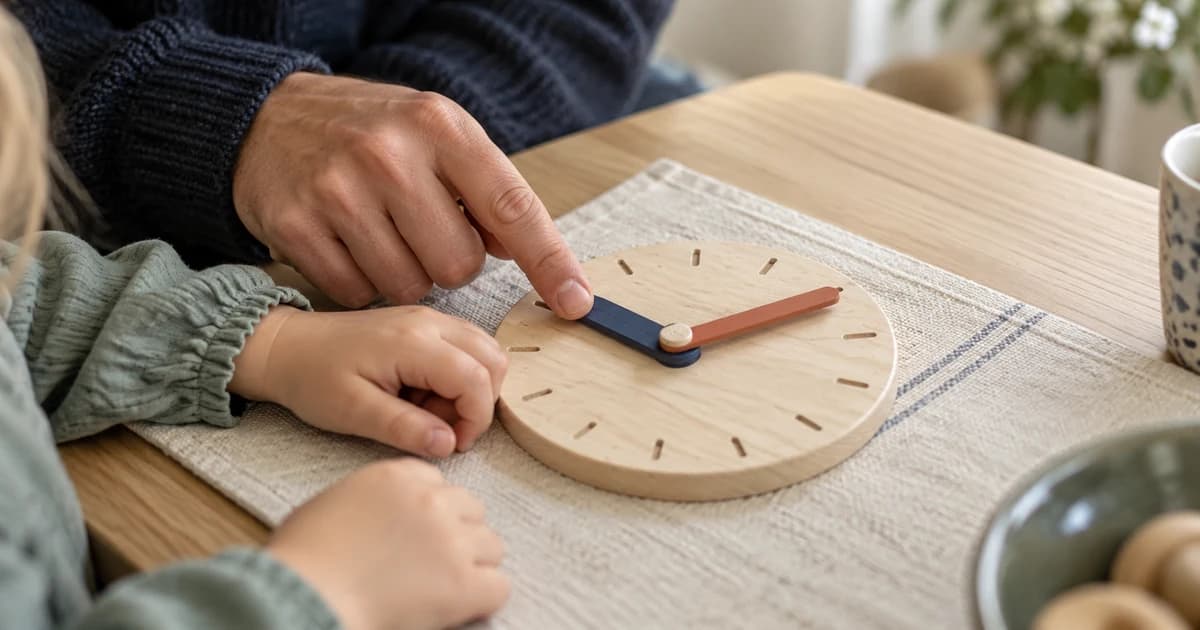
Begin with the basics: what the two hands do and what whole hours look like. Then connect the clock with familiar moments in your child’s day and practise a little at a time. Half hours, quarters and individual minutes build on that understanding.
An analogue clock has plenty of information in a small space: an hour hand, a minute hand, twelve numbers and sixty small marks. If there is also a thin second hand, leave it aside at first. It is fine if your child needs to revisit the same idea many times.
What does a child need to understand first?
The two hands have different jobs. The short hand shows the hour. The long hand shows how far through the hour we have travelled.
Trying to read both hands as ordinary numbers at once can be confusing. Take one at a time. Point to the short hand and name its job, then do the same with the long hand.
Their relationship is easier to show than explain. While the long hand makes one complete turn, an hour passes and the short hand moves forward by one number.
Whole hours are a useful place to start because the long hand points straight up at twelve. Your child only needs to read the short hand. If breakfast is at seven, look together: the long hand points up and the short hand points to seven.
How can you connect the clock with everyday life?
Say the time when something your child cares about happens. Begin with whole hours: “It is four o’clock, so we can go outside.” “It is six o’clock and dinner is ready.” The numbers then connect with experiences they know.
Put a clock where your child can see it easily, perhaps at their height in the kitchen. They can look for themselves rather than always needing to ask. Later, turn it around and ask what time they think it is.
You do not need to set aside a long session. A couple of minutes at breakfast or bedtime can keep the idea familiar. When whole hours feel comfortable, add half hours and quarters. Read more about the order for learning the clock.
What could you try tonight?
Start with the hands and one whole hour that means something to your child:
- Find an analogue clock or draw one with numbers from one to twelve.
- Ask your child to point to the short hand and the long hand.
- Set a familiar hour, such as dinner time, and read it together.
- Say the same time aloud when it actually arrives.
That is enough for one evening. If it feels easy, try another hour tomorrow. If it feels difficult, revisit the same one. You can find more ideas in practising time at home.
Klokkeappen is a tool for practice and repetition, offering spoken tasks about analogue, digital and English time without advertising. Explain unfamiliar ideas first, then use the app for further practice.