How can we practise telling time at home?
Practise telling time for a few minutes each day, give your child small timekeeping jobs and notice the effort as much as the answer.
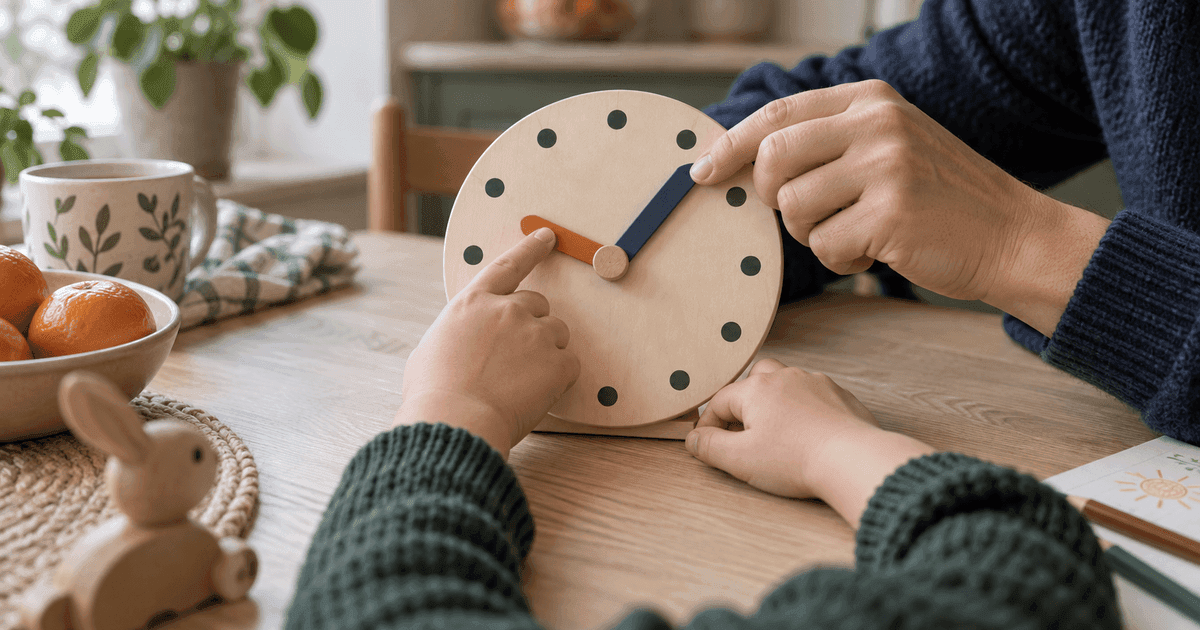
You can practise telling time with your child for a few minutes a day, ideally at a familiar point in your routine. Give your child small timekeeping jobs and notice the effort as much as the correct answer. Practice can then become an ordinary part of the day.
You do not need teacher training. An analogue clock, which is a clock with hands, some patience and a moment when you both have a little energy are enough.
How long and how often should we practise?
A few minutes a day is a useful starting point. A short session can finish before your child gets bored, leaving them more willing to try tomorrow. A regular time, such as just after dinner, helps it fit into the day.
Let the clock show how long you will practise. Before starting, say: “We will finish when the long hand reaches three.” Your child can see how much time is left while also watching time pass.
Missing a day is fine. Several short moments are often easier to fit into family life than one long session.
What timekeeping jobs can a child do?
Give your child jobs where the clock has a purpose, such as announcing when it is time to go out or timing an activity. When a clock answers their own question, such as “Is dinner nearly ready?”, it starts to mean something. Try one of these:
- Clock watcher. “Tell me when the long hand points straight down, and we will go outside.”
- Timekeeper. Look at the clock before and after tidying and work out how long it took.
- Today’s plan. Set a toy or paper clock to show the next activity.
- Guess the time. On the way home, ask what time your child thinks it is, then check together.
Tonight, choose one job and try it around dinner. For more playful ideas, read about learning to tell time through play.
What if the answer is wrong?
Before correcting an answer, ask how your child worked it out. They may have read one hand correctly and confused the other. That means part of the task is already understood.
For example, the clock shows half past eight, but your child says half past nine. They have noticed that the short hand is moving towards nine. The observation is useful, even though the answer needs adjusting.
You could say: “You saw that the short hand is on its way to nine. Which number has it already passed?” This gives your child a chance to correct the answer themselves.
Notice the thinking and effort as well as correct answers. A child who feels comfortable guessing gets more chances to practise than one who always waits to be told. If you are wondering how apps fit into family screen time, read about learning apps and screen time.
Klokkeappen can be one part of practising at home. It offers spoken tasks and games at the child’s own pace. The everyday timekeeping jobs are yours to give.